How weather radar follows bird migration across the CSRA
AUGUSTA, Ga. (WRDW/WAGT) - Each spring and autumn, billions of birds journey across North America, guided by seasonal changes in food supplies, weather patterns, and the instinct to reach breeding grounds or winter havens. Most songbirds travel under cover of darkness to avoid predators and take advantage of cooler, calmer air.
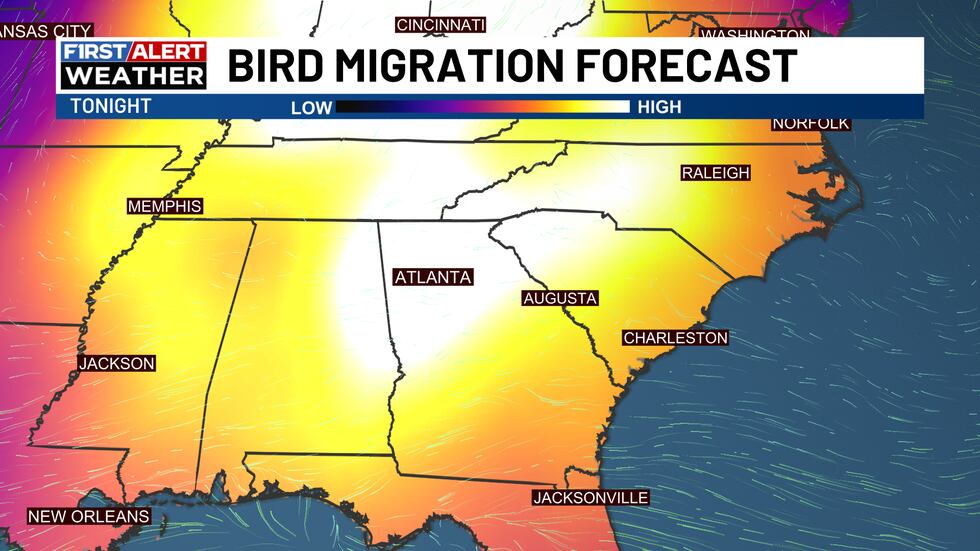
While Doppler weather radar is primarily designed to track rain, storms, and wind, it also detects biological targets—a field known as aeroecology. Platforms like BirdCast translate weather radar signals across Georgia into actionable migration data:
- Detection & Separation: Radar pulses reflect off millions of migrating birds aloft. Because birds move in coordinated directions and speeds distinct from raindrops or clouds, dual-polarization radar separates biological echoes from weather phenomena.
- Counting & Biomass: Algorithms convert radar reflectivity into bird density, estimating both active birds in flight and the total volume crossing state lines.
- Flight Dynamics: Radar measures heading, flight speed, and altitude—typically showing migration taking off 30 to 45 minutes after sunset, peaking 2 to 3 hours later at altitudes between 2,000 and 5,000+ feet.
Recent Migration Numbers: Georgia Skies Over the Last 5 Days
Fall migration accelerates rapidly through mid-September across the Southeast. According to BirdCast’s Georgia Migration Dashboard, nearly 53 million birds crossed the state over the past five nights, highlighted by a massive migration event on Sunday night:
| Date / Night | Estimated Birds Crossed | Activity Level & Highlights |
|---|---|---|
| Wed, Sep 9 | ~1.61 million | Low/Moderate movement |
| Thu, Sep 10 | ~2.35 million | Steady nocturnal flight |
| Fri, Sep 11 | ~1.05 million | Slower movement under local conditions |
| Sat, Sep 12 | ~8.24 million | Migration picks up across northern & central GA |
| Sun, Sep 13 | ~39.68 million | Season-high surge (peak traffic reached 51.04M birds in flight at midnight, moving South at 22 mph, altitude ~3,500 ft) |
| 5-Day Total | ~52.93 million birds | Cumulative season total now exceeds 135 million birds |
Protecting Migrating Birds Around Residential Homes
As highlighted by Birds Georgia through initiatives such as Project Safe Flight and Lights Out Georgia, glass collisions and artificial light represent major threats. Between 365 million and nearly one billion birds die each year in the U.S. from building strikes. Bright lights lure nocturnal migrants off course into urban and suburban neighborhoods, where reflective glass during the day causes fatal impacts.
Homeowners can take practical steps to protect migrants passing through their neighborhoods:
- Participate in “Lights Out”: Turn off non-essential outdoor decorative and flood lighting, and close interior blinds or curtains between 11:00 PM and 6:00 AM during peak migration (September through October).
- Treat Windows with Visual Markers: Apply dense patterns to exterior glass surfaces (such as Feather Friendly collision tape, decals, external screens, or tempera paint). Space markings using the 2x2 inch rule so birds recognize glass as an impassable barrier rather than open sky or foliage reflections.
- Relocate Feeders and Bird Baths: Place bird feeders either within 3 feet of windows (so birds startled from feeders cannot build enough flight speed to injure themselves) or more than 30 feet away.
- Move Indoor Plants Away from Glass: Position indoor greenery away from windows, as outdoor birds often mistake houseplants for natural perches and attempt to fly toward them through reflective panes.
Copyright 2026 WRDW/WAGT. All rights reserved.